Vaikuntam & Lokas
http://andaljeeyar.org/news.html
http://www.thehindu.com/todays-paper/tp-miscellaneous/sole-refuge/article6099938.ece
https://books.google.ae/books?id=evmiLInyxBMC&pg=PA233&lpg=PA233&dq=leela+vibhooti+nitya&source=bl&ots=aZuWkBKeXN&sig=kPjfsQNBeMAiu5Y5EWAurKUQljw&hl=en&sa=X&ved=0ahUKEwilysqSlpXSAhWEQBQKHWb7A1MQ6AEITzAJ#v=onepage&q=leela%20vibhooti%20nitya&f=false
http://sriranganatha.tripod.com/id138.html
Vaikuntam -
Paramapadam
Srirangam,
also known as Bhuloka
Vaikuntam
Kaveri to
be Viraja. After
bathing in Viraja,
atman will
encounter Vaikuntam.
arcchiradi marg or
path, leading to Vaikuntam
crossing Moola
prakruti and Viraja river,
atman enters Vaikuntam
1. Archit -
This is the first stage. Archit means
light. Atman travels
from darkness in this world to brightness.
2. Day -
This is not indicative of time, but the god representing that stage. Accepting
their welcome, atman travels
further.
3. Shukla Paksh -
Representing the brighter portion of Moon, from Amavasya [New
moon] to Pournami [Full
moon].
4. Uttharayana -
Six months from Tamil month Thai to Aadi.
5. Samvatsaram -
Stage representing year.
6. Vayu lok -
Place of wind.
7. Surya mandalam.
8. Chandra mandalam.
[This may look reverse of our science learnt in schools. But this is the order
mentioned in Upanishads]
9. Vidyut lok -
stage of lightning. The god here Amanava,
will accompany the atman and
guide to Vaikuntam.
10. Varuna lok.
11. Indra lok.
12. Satya lok of
lord Brahma.
Then comes Moola
prakruti or
primordial cause. It is a a tall, wide and long mass. Crossing this, atman reaches Viraja river.
After bathing in this river atman enters Vaikuntam. This
path is called Archiradi
marg. 'Nachapunar avartate'
- those travelling in this route never return [to samsaram]. This is what we
will see in sloka 45:
Pramanas on Vaikuntam and Archirardi
Margam: Chandogya Upanishad, KaTa upanishad, BrihadaaraNyaka upanishad,
Kaushidaki Upanishads, Paryanka vidhya, Bhagavad Gita, Thiruvaimozhi.
Ramanujar's Gadya Thrayam - Srivaikunta Gadyam, Vedanta Desikar's work Parama
pada Sopanam and many more.
Nitya VIBHUTHI / Bogha
Vibhuthi (Pure Satva -
suddha sattva)
Nithya vibhuti is 3 times bigger than
leela vibhuti.
LEELA VIBHUTHI
triguna divya vyatirikta (sattva, rajas and tamas)
SAMSARA MANDALAM /
ANDA KATAKA /
Prakriti
PATH -
Leela Vibhuti includes many many andam,
each andam is 50 crore yojanai length. Anda katakam is covered by 7 avaranas -
appu, tejas, vaju, akasam, ahankaram, mahan, moola prakruthi.
The anda is covered by avaranas which are water, fire, wind, akasa, ahankara,
mahath and avyaktha.
|
01 |
Satya-loka |
Upper Loka |
Pancha sathu koti yojana
50 Crores 10 miles apart |
|
02 |
Tapa-loka |
|
03 |
Jana-loka |
|
04 |
Mahar-loka |
|
05 |
Svar-loka |
|
06 |
Bhuvar-loka |
|
07 |
Bhu-loka |
|
08 |
Atala-loka |
Lower Loka |
|
09 |
Vitala-loka |
|
10 |
Sutala-loka |
|
11 |
Talatala-loka |
|
12 |
Mahatala-loka |
|
13 |
Rasatala-loka |
|
14 |
Patala-loka |
Dhoomadhi Margam - Chandra Lokha, Surya Lokha
Archanadhi Margam - Vaikundam
Jambudvīpa
Jambudvipa, Plaksadvipa, Salmalidvipa, Kusadvipa, Krouncadvipa, Sakadvipa, and
Pushkaradvipa
Seven intermediate oceans consist of salt-water, sugarcane juice, wine, ghee,
curd, milk and water respectively


Surya Devata
mANU
IShkWAGU - aYODYA KING
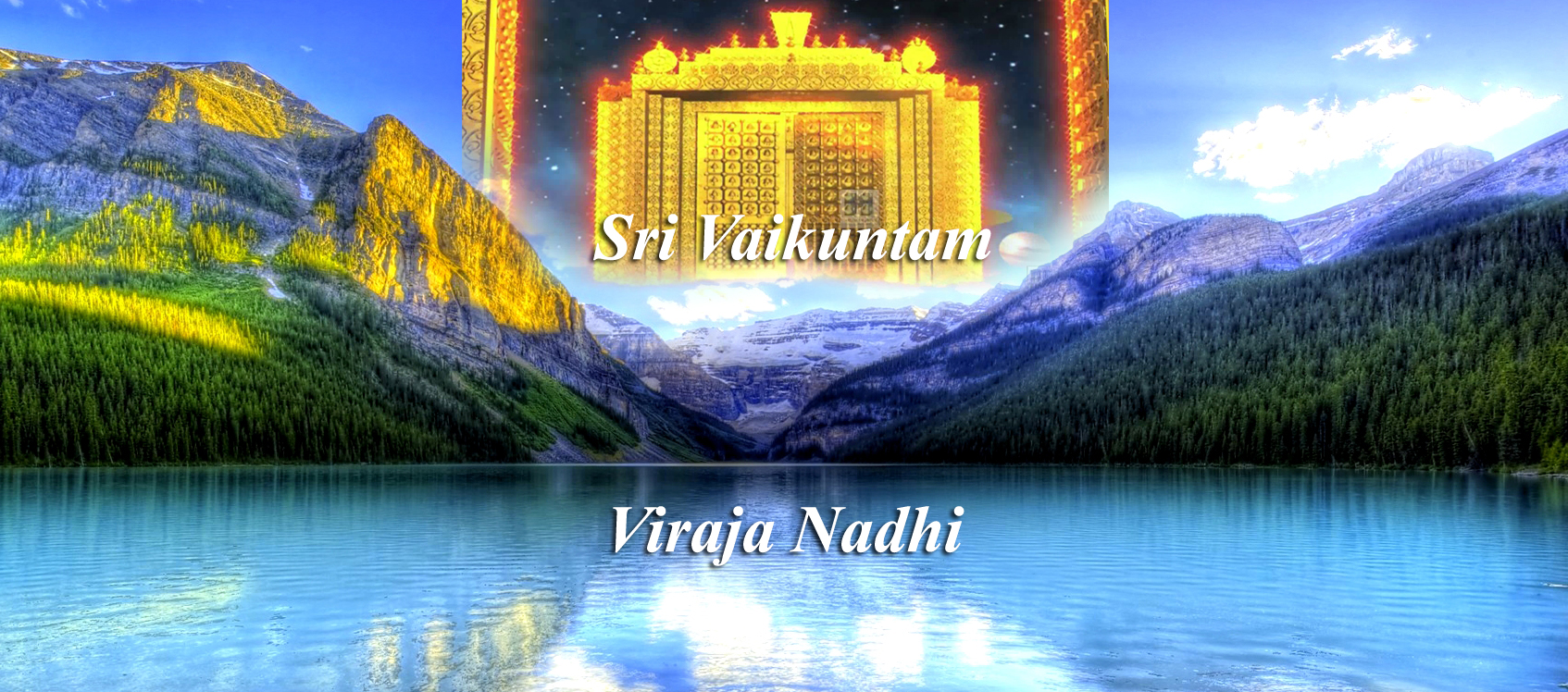
Virajai, the sacred river in Sri VaikuNTam
referred to "Amaparam " earlier as
AakAsam or Sri VaikunTam (ParamAkAsam). The next dhAnam that NandagOpan is
known for is the giving away of water (TaNNIr) for those , who are thirsty.
TaNNIr here stands for Virajai, the sacred river in Sri VaikuNTam. The One ,
who bathes people in Virajai is recognized as NandagOpan. "sORu" is the annam identified in Upanishad ( annam BrahmEthi vyajAnAth). AchAryan is the One , who
helps us experience BrahmAnubhavam with Saama GhAnam ( ahamanAthOham annAthOham).
As Swamy NammAzhwAr recognized ( " Yeduttha pErALan NandhagOpan " ), the king
of Gokulum is equatable to AchAryan.He had the incomparable wealth of KaNNan as
his child and had ParipUrNa BrahmAnubhavam
Moola Prakruthi
Leela Vibhuthi - Virajai Nadhi (River) - Paramaakaasham (Sri Vaikundam) - Nithya
Vibhuthi
Acharardhi margam
archanadhi margam
12 lokas
Muktha jeeva
Atma crosses 12 lokhas
Aprakrutha shareera
after Virajai nadhi bathing reach Nithya mandala
Urthva lokas & Patala
In the Puranas,
and already in the Atharvaveda,
there are fourteen worlds, seven higher ones (Vyahrtis) and seven lower
ones (Pātālas),
viz. bhu, bhuvas, svar, mahas, janas, tapas,
and satya above
and atala, vitala, sutala, rasaataala, talatala, mahaatala, patala and naraka below.
The scholar Deborah Soifer describes the development of the concept of lokas as
follows:
The concept of a loka or
lokas develops in the Vedic literature. Influenced by the special connotations
that a word for space might have for a nomadic people, loka in
the Veda did not simply mean place or world, but had a positive valuation: it
was a place or position of religious or psychological interest with a special
value of function of its own.
Hence, inherent in the 'loka'
concept in the earliest literature was a double aspect; that is, coexistent
with spatiality was a religious or soteriological meaning, which could exist
independent of a spatial notion, an 'immaterial' significance.
The most common cosmological conception of lokas in the Veda was that of
the trailokya or triple world: three worlds consisting of earth, atmosphere or
sky, and heaven, making up the universe.
Upanyasam Series: Archiradi Margam
This post is based on an Upanyasam "Archiradi Margam - Path of light" by Swami
Velukkudi Krishnan delivered many many years ago.
Introduction
The ultimate purushartham for a jeevathma is to attain moksham and perform
kainkaryam at bhagawan's lotus feet at Sri Vaikuntam - the eternal abode of
Sriman Narayanan.
For a jeevathma to attain moksham he needs to get rid of the karma baggage
through one of the two upasana - bhakthi or prapatti / Saranagathi.
Once the karma baggage is lost the jeevathma is eligible for moksham to enter
the eternal abode.
The path in which the athma travels from the body of a jeevan to reach the
eternal abode of Sri Vaikuntam is called "Archiradi Margam" - the path with
light has its beginnning. Archis means light.
Karma & Moksham
Thus a jeevathma need to get rid of the punya/papa karma to attain moksham.
First a jeevathma need to seek an acharya who will perform the samashreyanam for
the jeevan and teach him how to live the life and give him knowledge. Later
Bharanyasam is also performed by the acharyan who recommends to Lord on behalf
of the jeevathma.
It is the duty of the Jeevan to act as per the rules of the shastras after
samashreyanam and Bharanyasam. These are not just formalities.
For example ..if one gets a job then will get a salary. Here it is implied that
if one gets a job AND HE DOES THE JOB then he will get salary. Similarly, If one
does Samashreyanam AND IF HE LIVES AS PER THE RULES STATED IN SHASTRAS then he
will attain moksham.
Anyone who has bhakthi can attain moksham.
Anyone who understands that Bhagawane Parama Purushartham and is focused on this
will attain moksham.
So to attain moksham
One need to be devoted i.e Bhakthi
One need to wish to attain the end goal of reaching moksham
Should stay away from Bhagavath apachAram, BhAgavatha apachAram.
One should stay among good company and need to stay away from bad company,
people who talk bad about our sampradhayam. If anyone talks bad about acharyan
it is better to explain them in a crisp way and then stay away from them
thereafter. No point in wasting time in bad company. "Sath thoda koodi irukanum".
Need to be aware of dhosams due to saga vasam, saga bhojanam and saga
varthaalabham. Need to spend time with good people , eat with good people and
speak to good people. Because of bad company "Samam Dhamam kuraiyum".
If anyone wants to attain moksham they
need to do
-
Possess the knowledge on our shastras
-
Perform all the aachaara anushtanam
-
Need to show premam ( affection and
love to other jeevan)
-
Develop quest for mukthi
Everyone in this world are samsari and they can be classified as
-
Mumukshu - Who are eager and working
towards moksham
-
Bhubhukshu - Who are focused in
materialistic things. It means one who is focussed in eating "saapatukku aasai
padugiravan bhubhukshu"
-
Vedanta Desikan says that one who is
focussed to attain moksham need to possess "nirvetham" which means developing
hatred towards samsaram. "Samsarathil adi kothipu, veruppu".
-
Need to be focused in perumal and
nothing else.
-
Even while introducing self need to
introduce by saying the kainkaryam we do to perumal and at divya desams.
Introducing with details related to materialistic world is again going to push
us into samsaram only.
Various terms to refer Eternal abode :
Nithya Vibhuti is also known as
-
Sri Vaikuntam,
-
Anthamil Perinbham,
-
Thirunaadu,
-
Parama vyomam,
-
Nalam anthamilathoru naadu,
-
Thelivisumbhu thirunaadu ,
-
Maaga vaikuntam,
-
Vaikuntam,
-
moksha mandalam,
-
nithya mandalam
-
Nithya vibhuti
-
Parama Padam
-
Parama Akasam
Peruman is in Para roopam at Nithya
vibhuti.
Vaikuntam means kuraive aganrathu yengo athu vaikuntam, kuraivatrathu yetho athu
vaikuntam.
Vaikuntam - kuntaha vikathaha
Kuntam means kuraivu, alavukku utpatta jnanam i.e restricted knowledge.
Vikunta means complete, alavukku utpadatha jnanam, bhakthi.
Vikathaha means odipochu, vilaginathu
What was lacking in the leela vibhuti which was rectified when reaching
vaikuntam ?
Jnanam and bhakthi was lacking while in this leela vibhuti. Vaikuntam is the
place where a jeevathma gets rid of the ignorance and is in permanent bliss in
its true nature - Swaroopa avirbhavam.
Nithya Vibhuti and Leela Vibhuti
Leela Vibhuti is the samsaric abode & Nithya vibhuti is the eternal abode.
Vaikuntam is the Nithya Vibhuti and the world we live in is Leela Vibhuti.
At Vaikuntam there is no end to good things. It is like utsavamas forever.
Nallathuku antham illai.
Unlike leela vibhuti, Vaikuntam is not mix of sugham and dhukham. It is only
sugham at vaikuntam.
Leela vibhuti is ruled by the 3 Guna's due to prakrutha sambhandam and satvam
here is mishra satvam. NIthya vibhuti vaikuntam is of Shuddha satvam / thathvam
and it is aprakrutham. Mishra satvam in Leela vibhuti results in reduced
knowledge and cannot glow on it own. Shuddha satvam can glow on its own.
In Nithya vibhuti, sukham is in its pure form. In leela vibhuti, everything is
Prakrutham i.e impacted due to Satva, Rajas, Tamo gunas. In Nithya vibhuti it is
aprakrutham i.e Suddha Satvam ( note that this satva is different from Satvam as
in leela which is mixture)
In Nithya vibhuti there is no karma vasanai
Nithya vibhuti is the place where nithya jeevan and muktha jeevan are with
Paramathma enjoying bhagavad anubhavam performing kainkaryam.
In Nithya vibhuti there is no kamam, krodham, lobham, madam, mathsaryam, hunger,
rebirth, disease, oldage.
Nithya vibhuti is not created or destroyed like leela vibhuti during pralayam.
Nithya vibhuti is 3 times bigger than leela vibhuti. Leela Vibhuti includes
many many andam, each andam is 50 crore yojanai length. Leela vibhuti is closed
by 7 avaranas - appu, tejas, vaju, akasam, ahankaram, mahan, moola prakruthi.
Viraja river is the demarcation between Nithya vibhuti and leela vibhuti.
Perumal is ubhaya vibhuti Nathan - owner of both the vibhuti.
Nithya Vibhuti is ruled by Bhagawan. Leela vibhuti is controlled by time/Kalam.
Nithya vibhuti is with clear clouds thelivisumbhu thirunaadu. Leela vibhuti is
full of confusion. Leela vibhuti has people who confuse and people who get
confused too.
Even in leela vibhuti one can stay away from materialistic things. Azhwar in
Thiruviruttam tells to live a life as in NIthya vibhuti like a Hamsa bird which
is capable of walking on the swampy region without getting sucked into it.
To explain this concept of Nithya vibhuti and Leela vibhuti, at Srirangam there
is a permanent mandapam called "thirumaamani mandapam" which is equivalent to
Nithya vibhuti and outside a temporary mandapam is built every year during
vaikunta ekadashi to depict the concept of leela vibhuti which is impermanent.
Vaikunta Ekadasi is actually a drama to explain how a muktha jeevan travels from
leela vibhuti to nithya vibhuti. Saying "Swarga Vasal" is incorrect during
vaikunta ekadasi since swargam is part of prakruthi and it is different from
Vaikuntam. There are 6 parimanam which happens as explained in "Suzhundu.."
Thiruvaimozhi 10.10.10 pasuram.
What was lacking in the leela vibhuti which was rectified when reaching
vaikuntam ? Jnanam and bhakthi was lacking while in this leela vibhuti.
Vaikuntam is the place where a jeevathma gets rid of the ignorance and is in
permanent bliss in its true nature - Swaroopa avirbhavam.
"Narayanane Namakke Parai Tharuvan" - He is the only means. People who do not
have other means except perumal seek him to reach him. "Parai" here refers to
Kainkaryam, moksham and purushartham.
Karmam is the cause for us to stay away from Bhagawad anubhavam and like how a
baloon travels upwards when the thread is cut, the jeevan starts its journey to
the eternal abode when the karma bondage is cut off.
Is there anyone who has gone to vaikuntam to talk about vaikuntam ? No one in
this samsaric world including the brahma and the devas have not seen vaikuntam.
The one who had seen vaikuntam are the nithya jeevans and muktha jeevans who
will not come to this samsaric world to talk about vaikuntam.
Then how do we get to know about vaikuntam ? Upanishad talks about vaikuntam.
Chandogya Upanishad, KaTa upanishad, BrihadaaraNyaka upanishad, Kaushidaki
Upanishads, Paryanka vidhya, Bhagavad Gita, Thiruvaimozhi talks about the path
leading to vaikuntam, who go to vaikuntam, how do they go to vaikuntam, what
happens once a jeevathma reaches vaikuntam, what happens to the jeevathma after
reaching vaikuntam, Why does the jeevathma does not come back from vaikuntam are
all told in detail in shastram.
People who have reached vaikuntam
might not be able to come back to explain to us. But since it is told in the
shastram we need to believe and accept it. Nithya suri's are nithya jeevathma
who have been in Vaikuntam forever like Sangam, chakaram, Vishwaksenar, garudan.
These nithya suri's send jeevathmas with their amsam to bhuloka. Chakrathazhwar
came down as Thirumazhisaiazhwar, Vishwaksenar came down as Nammazhwar, Garudan
came down as Periazhwar, Adi seshan came down as puliya maram, lakshmanan,
Ramanujar, Manavala Mamunigal. So these jeevathmas had come from vaikuntam and
they have spoken about vaikuntam in their pasurams and works. So it is not a
good to just be reluctant and ignore the words of these azhwar, acharyas which
is also told in the shastram. Though we are trying to understand from the
shastram, still it seems as if we know and also know very little. This is the
greatness of vaikuntam.
Nithya soori's and muktha jeevans stay forever in the eternal abode, singing the
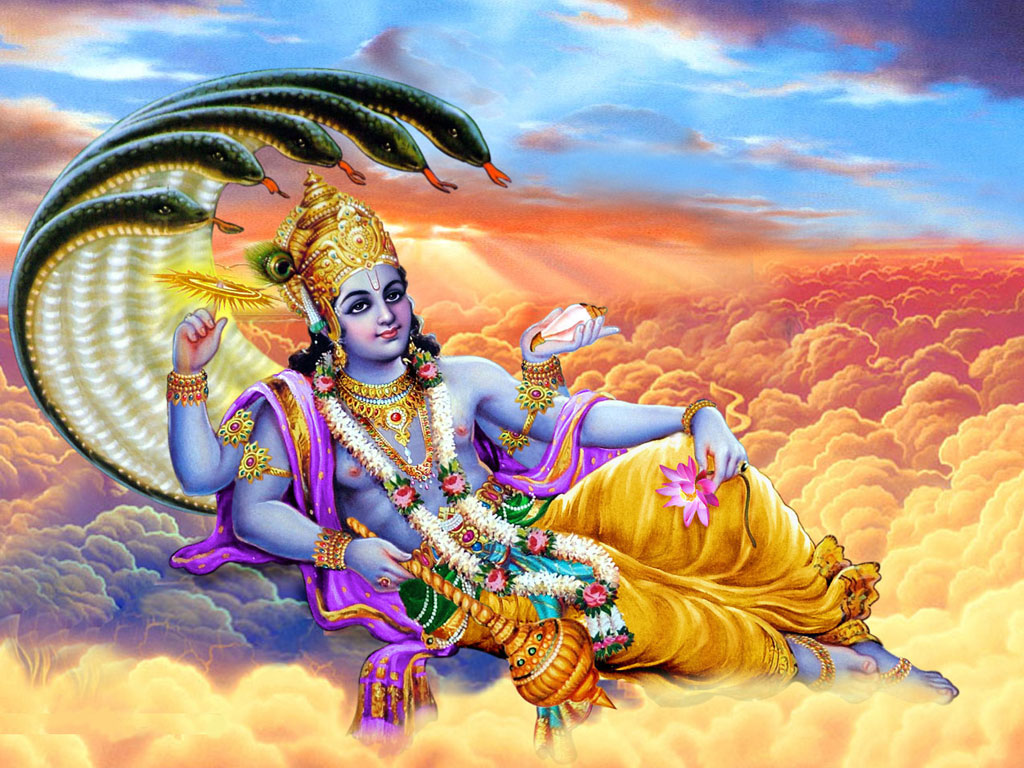
sama ganam "aahu aahu...". Perumal is seated in the Adhishesha pariyankam with
his 3 consorts Sridevi on his right, bhumi devi and neela devi on his left.
There are also many many lokas in Sri Vaikuntam to have anubhavam of Rama,
Krishna, Narasimha as in many many avatharams.
There is no restriction for any type of anubhavam while in Sri Vaikuntam.
Muktha jeevans take various forms to perform various kainkaryams.
Sri Vaikunta Sthavam Kuresar explains that when compared to the brightness of
vaikuntam even 1000 sun's light looks dark, when compared to the brightness of
Perumal's kreedam the vaikuntam looks dark, when compared to the brightness of
perumal's face the kreedam looks dark. Such is the brightness of perumal's divya
mangala thirumeni.
In Vaikunta Gadyam, Swami Ramanujar beautifully explains about Sri Vaikuntam.
Brahma or rudran have also not yet gone to this place and still dreaming about
it.
Vaikuntam is far from Swarga lokam of Indran and Satya lokam of Brahma. It is
like comparing the distance of the moon from the ground and from the ladder.
Krishna in Bhagavad gita explains that a jeevan who reaches vaikuntam does not
go back to samsaram. No punarjanmam for that jeevan.
While in Sri Vaikuntam, a jeevan attains equality i.e Samyam in 8 things with
Paramathma. Hence this moksham is also referred to Samyapathi moksham in
Vishista advaitham. During Samyapathi moksham a jeevan attains equality with
Paramathma in 8 Gunas which are
1. apahathapa:pma – not touched by sins
2. vijaraha – no old age
3. vimruthyuhu –no death
4. viso:kaha – no sorrow
5. vijigithsaha –no hunger
6. apipa:saha – no thirst
7. sathya ka:maha – stays with all kalyana guna and always wishes for the well
being.
8. sathya sankalpaha– anything thought or wished for, becomes true
The jeevathmas possess this quality even when he is in Samsaram but all these
are for stipulated time. e.g We don't feel hungry for few hours. In vaikuntam
since a jeevan is freed from Karma noting is bound by time and is timeless,
athma has got jnana vikasam and athma keeps enjoying brahmam - brahmanubhavam.
This is nithya anandam and this is called as vaikuntam.
Samyapathi can be understood from Andal's pasuram "maale manivanna.." and in the
end she says "aalin ilayai arul" - "perumale Grant me these things which you
have".
Vaikuntam is a place a jeevan travels to & not State of Mind Is vaikuntam a
place to which a jeevathma will travel to or is it a state of mind which can be
obtained while in this world itself? Vaikuntam is a place to which a jeevan
travels too and it is not a state of mind. Jeevan mukthi is the concept by
Advaiti's where they say that a soul gets liberated while in this world and
liberation is a mental state. This is not true since there are upanishad
vakhyams which explain about the path traveled by a jeevan and the explanation
of vaikuntam. If in case mukthi or vaikuntam is a state of mind then once a
jeevathma attains mukthi while in this world, it has to undergo some
transformation and that jeevan need to be away from this karmic problems. A
jeevan cannot continue to be in this Karmic bhoomi post mukthi. Hence mukthi is
not just a state of mind.
1. Mundaka Upanisad III.I.VIII beginning
"tatha vidva punya-pape vidhuya niranjana param samyam upaiti"
means: The atma casting off the dross of merit and demerit becomes purified
attaining qualitative sameness in transcendence as the brahman.
Thus explaining Jeevathma attains samyapathi with paramathma.
2. Bhagavad Gita also explains this as
idam jnanam upasritya mama sadharmyam agatah
sarge 'pi nopajayante pralaye na vyathanti ca - 14.2
Meaning: By becoming fixed in this knowledge, one can attain to the
transcendental nature like My own. Thus established, one is not born at the time
of creation or disturbed at the time of dissolution.
3. Taittriya Upanishad - "Soshnute sarvan kaman saha brahmana avipaschiteti"
4. Chandogya Upanishad 8.12.3 - "tavad esha samprasado 'smac charirat
samutthaya param jyoti-rupam sampadya svena rupenabhinishpadyate sa uttamah
purushah."
Meaning: "The Supersoul coming out of the body enters the impersonal brahmajyoti;
then in His form He remains in His spiritual identity. That Supreme is called
the Supreme Personality."
5. "tam padyena adya rogathe......." - meaning itho intha margathil selgiran.
Upanishad explains about ArchirArdi margam.
6. The one who takes this ArchirArdi margam does not come back. Even the one who
has taken the path towards satya loka (brahma's abode) need to come back.
Bhagavad Gita - 16.8
abrahma-bhuvanal lokah punar avartino 'rjuna
mam upetya tu kaunteya punar janma na vidyate
Meaning:From the highest planet in the material world down to the lowest, all
are places of misery wherein repeated birth and death take place. But one who
attains to My abode, O son of Kunti, never takes birth again.
7. Upanishad says - nacha punar aavarthathE nacha punar aavarthathE - "He never
returns back to this world, He never returns back to this world"
8. Veda vyasar in Brahma Sutra has one chapter for "phala adhyayam" explicitly
to explain the fruits (phalan) of reaching paramatma. Brahma sutra thus in this
chapter talks about "utkaramanam" - to explain how the jeevan starts its journey
from the sareeram, what is the path(margam) taken by this jeevathma, where does
this muktha jeevan go to, who all dresses up this muktha jeevan are all
explained in detail.
9.Kaushitaki upanishad, Katopa upanishad and paryanka vidhyai also talks about
this path taken by muktha jeevan and about Vaikuntam which is called as "Archirardi
Margam".
5 sloka's in Kurathazhwan's Vaikunta
sthavam about Vaikuntam :
Attributes of Vaikuntam are given in the slOkams 41 onwards up to the third
paadham of the 45th SlOkam.
Slokam 41
yadh VaishNavam hi paramam padam aamananthi
kham vaa yadhEva paramam tamasa: parasthAth |
tEjOmayam parama-satthvamayam dhruvam yadh
aananda-kandam athisundaram adhbhutham yath ||
MEANING:
(The ancients describe the place named Sri VaikuNTham as Your permanent abode)
that is saluted as the Supreme abode of VishNu; it is the same Supreme abode of
the Lord and is the ParamAkAsam beyond Tamas known otherwise as Moola Prakruthi;
it is the place which is full of lustre and is Suddha Satthvamayam (free from
any admixture of RajO or TamO guNams); it is eternal,the basis of all bliss, the
most beautiful and wondrous.
Slokam 42
yadh Brahma-Rudhra-PuruhUtha-mukhai: durApam
nithyam nivrutthinirathai: SanakAdibhirvaa |
Saayujyam ujjvalam usanthi yadAparOkshyam
yasmAth param na padam anjithamasthi kimchith ||
MEANING:
(The ancients describe the place named Sri VaikuNTham as Your permanent abode)
That is unattainable even by Brahma Devan, Sivan, Indhran and SanakAdhi
Maharishis engaged always in travel by the Moksha Maargam; the visualization of
that land is equal to the enjoyment of the bliss on a par with the Lord Himself;
That land, which is the place of Your permanent residence has no comparable
lOkam in status equal or superior to it (SrI VaikuNTham) as a place of worship.
Saayujyam is Samyapatthi moksham.
Note: There are four kinds of Moksham (SaalOkyam, Saaroopyam, Saameepyam and
Saayujyam).
The supreme most among them is Saayujya Moksham. Gaining the anubhavam of bliss
on a par with the Lord (Sama rasAnubhavam) and performing nithya kaimkaryam to
the Lord is the Supreme Moksham of Saayujyam. The other three kinds of Moksham
are subsumed in Saayujya Moksham. KurEsar refers to this incomparable Saayujya
roopa Moksham in the third paadham of this slOkam: “Saayujyam ujjvalam usanthi”.
Slokam 43
roopENa sadh-guNagaNai: parayA samruddhyA
bhAvai: udhAra madhurai: api vaa mahimnA |
taadhruk tadh Idhrug-idham ithi upavarNayanthyO
vaachO yadeeya vibhavasya thiraskriyAyai ||
MEANING:
Through its JyOthirmaya form (roopENa), through its assembly of auspicious
attributes that bless one with Jn~Anam and Kaimkarya prApthi, through its
abundant aiswaryam
(paramA SamruddhyA), through its delectable supreme bliss (udhAra Madhurai:
bhAvai:) and other special vaibhavams, this Sri VaikuNTham possessing the above
glories can
not be described/defined adequately as this or that (tadh taadhruk idham Idhruk
ithi upavarNayantya:). Such words/efforts/attempts to describe these glories as
this or
that become like curtains hiding these indescribable Vaibhavams of Sri
VaikuNTham, which is your incomparable Supreme abode.
Innathu innayathu yendru varnikka mudiyatha idam vaikuntam i.e a place which is
beyond explanation of what it is and how it is.
All one can say is that there exists a place called SriVaikuntam and one has to
go there to experience what it is and how it is.
Slokam 44
yadh vrudhyapakshaya vinAsa mukhai: vikArai:
yEthai: asamsthutham anasthamitha asthi sabdham |
yadh gouravAth Sruthishu phalgu phalam kriyANAm
aadishtam anyath asukhOttharam adhruvam cha ||
MEANING:
The Supreme abode of yours (Sri VaikuNTham) is free from changes based on growth
and dissolution (Vruddhyapakshaya vinAsa mukhai yEthai: asamsthutham). This is
the
place, where the word “asthi” (present) never ceases to exist (anasmith asthi
sabdham).
The fruits arising from the performance of the Yaaga Yaj~nams recommended by the
VedAs become insignificant compared to the fruits arising from residence in Sri
VaikuNTham and end in sorrow instead of lasting bliss. That indeed is the
glorious and eternal place of residence of yours saluted as SrI VaikuNTham.
Slokam 45
nishkalmashai: nihatha janma jarA-vikArai:
bhUyishta bhakthi vibhavai: abhavai: avApyam |
anyai: adhanya purushai: manasaa api anApyam
VaikuNTha naama tava dhAma tadh aamananthi ||
MEANING:
The SadAchAryAs instruct Sri VaikuNTham as Your Cherished Supreme abode, which
is attainable only by those who are free from desire, anger et al and only by
those who
do not experience the changes of birth, aging et al. They instruct us that Your
Supreme abode is attainable only by those who are Mumukshus with no desire in
future births and perform Bhakthi or Prapathti yOgam to be blessed with Sri
VaikuNTha Vaasam and Kaimkarya SaamrAjyam. For all the others bereft of these
qualifications, Your Supreme abode of Sri VaikuNTham cannot even be thought of
even by their minds. (bhUyishta bhakthi here refers to SarNAgathy).
In the above slokam, it is told about who are the ones who attain moksham and go
to vaikuntam. They are the ones who have athitha bhakthi and others cannot even
imagine/think about this place.
Liberation is Samyapathi moksham and not Iykiyapathi moksham
As per vishista advaitha, moksham is Samyapathi moksham.
As per advaita maya vadam, moksham is Iykiyapathi moksham.
Ramanujar explains Samyapathi moksham, "jeevathama brahmathodu serunthu
Brahmathai anubhavikiran". Here along with Brahmam and not brahmam himself.
In Samyapathi moksham, Jeevathma attains equality (samyam) with Paramathma in 8
things. During Samyapathi moksham a jeevan attains equality with Paramathma in 8
Gunas which are
1. apahathapa:pma – not touched by sins
2. vijaraha – no old age
3. vimruthyuhu –no death
4. viso:kaha – no sorrow
5. vijigithsaha –no hunger
6. apipa:saha – no thirst
7. sathya ka:maha – stays with all kalyana guna and always wishes for the well
being.
8. sathya sankalpaha– anything thought or wished for, becomes true
The jeevathmas possess this quality even he is in Samsaram but all these are for
stipulated time. e.g We don't feel hungry for few hours. In vaikuntam since a
jeevan is freed from Karma everything is timeless, athma has got jnana vikasam
and athma keeps enjoying brahmam - brahmanubhavam. This is nithya anandam and
this is called as vaikuntam. Samyapathi can be understood from Andal's pasuram "maale
manivanna.." and in the end she says "aalin ilayai arul" - "perumale Grant me
these things which you have".
Paramathma still possess these following unique qualities
1. Sriyapathithvam - Perumal with Piratti
2. Jagath Karanathvam - Which is further explained by 3 things - Akila Jagath
Karana, Adbhudha Karana, Nish Karana. Akila Jagath Karanam since perumal is the
cause for
the entire universe. Adbhudha karanam since perumal is hidden and we do not know
about the relationship with him. NIsh karanam because he is causeless. Brahmam
is a
creator for few lokas,
3. Moksha pradhathvam - Mukthi bhoomiyai kodukiravar
4. Vyapakathvam - Swaroopa daya vibhuthvam - Perumal is vibhu ( paranthu
virinthhu irutthal) using his swaroopam and rest all are anu (atomic). Note
that Lakshmi is also Vibhu since she is part of perumal but Perumal is the only
one who is Vibhu by nature.
5. Sarva Niyanththruthvam
6. Swathanthiran
7. Ubhaya vibhuti Nathathvam
8. Ubhaya linga vaishistan
Though a muktha jeevan has sankalpa capabilities he will not get involved since
the ultimate goal for a jeevan is bhagavad anubhavam and bhagavad kainkaryam.
Thus the main thing in this swaroopa aavirbhavam is that the jeevathma attains
Samyapathi with Paramathma - "Brahmathode samyapathi kittum". Samyapathi -"Samamaana
thanmai adaithal", apathi means adaithal i.e to attain, Samya means samamana
thanmai equality. Samyapathi -"Samamaana thanmai adaithal", apathi means
adaithal i.e to attain, Samya means samamana thanmai equality.
What is the equality that a jeevathma
get as in Paramathma ? Does jeevathma become Brahmam/Paramathma ? Does jeevathma
gets all capability that Paramathma posses like creation, destruction,
protection ? How does jeevathma become equal to Paramathma ? Does jeevathma
become SriyaPathi ?
Brahmam has 4 unique qualities -
Mokshapradhathvam, Sriyapathithvam, Jagath karanathvam, Vyapakathvam . When a
jeevathma attains Swaroopa aavirbhvam, the jeevathma becomes equal to brahmam
expect these 4 qualties- Mokshapradhathvam, Sriyapathithvam, Jagath karanathvam,
Vyapakathvam. Jeevathma will be in atomic form only.
Shastram says that Muktha jeevathma
has the ability to eat what he wants, take any form he wants to take, can do
whatever he wants to do with whomever he wants to play, can do whatever
kainkaryam he wants to do, can take how many every thirumeni he wants, can take
any thirumeni he wishes to, if he wish to see any other bhaddha jeevans he can
create them outside vaikuntam and see them through sankalpa shakthi(vaikundathin
veliyil utpathi panni parka mudiyum). Such are the abilities a muktha jeevan
gets but the question is will a muktha jeevan use these powers esp creation ?
No. All a muktha jeevan would like is just to be in bhagavad anubhavam
performing kainkaryam and hence even if he has powers he will not be interested
in doing other activities. Vedav vysar in Brahma sutram says "Jagath vyapaaram
varjam" to make sure that a mutha jeeva does not get into creation etc.
Note: Everyone need to make effort to
learn Brahma sutram. Learning brahma sutram will transform an individual. This
is a key to open the door of knowledge about atma and paramatma. Thus muktha
jeevan takes many many sareeram in vaikuntam and continues to do kainkaryam to
perumal. Muktha jeevan gets samyapathi in aanandam with Paramathma. Thus muktha
Jeevan stays as jeevan and paramatma is paramatma. However they attain
equality(samyapathi) in eternal bliss(aanandam). Though jeevathma is pure since
he has got rid of all the karma(Jeevan sheds papa punya like a horse which
shakes and shed his unwanted hair) still jeevathma is atomic ( anu) unlike
paramatma who is vibhu(omnipresent). Jeevan still continue to be Parathanthiran
unlike Paramatma who is swathanthiran. This type of liberation by Jeevathma is
referred as "Samyapathi moksham". Note that liberation is never Iykiyapathi
where a jeevathma becomes Iykiyam with Paramathma.
Pramanam to explain that Jeevathma cannot become Paramathma
Following are three key paramanas to explain that jeevathma cannot become
paramathma
Saamya Shruthi Vakhyam
Saadharmya Smriti Vakhyam
Saha Shruthi Vakhyam
1. Mundaka Upanisad III.I.VIII beginning
"tatha vidva punya-pape vidhuya niranjana param samyam upaiti"
means: The atma casting off the dross of merit and demerit becomes purified
attaining qualitative sameness in transcendence as the brahman.
Thus explaining Jeevathma attains samyapathi with paramathma.
2. Bhagavad Gita explains this as
idam jnanam upasritya mama sadharmyam agatah
sarge 'pi nopajayante pralaye na vyathanti ca - 14.2
Meaning: By becoming fixed in this knowledge, one can attain to the
transcendental nature like My own. Thus established, one is not born at the time
of creation or disturbed at the time of dissolution.
3. Taittriya Upanishad - " Soshnute sarvan kaman saha brahmana avipaschiteti"
Thus a jeevathma along with Paramathma enjoys the kalyana gunas of Bhagawan and
does not become bhagawan himself.
Pramanam and references to explain Samyapathi Moksham
1. Kannan says as follows
idaḿ jñānam upāśritya mama sādharmyam āgatāḥ
sarge 'pi nopajāyante pralaye na vyathanti ca 14.2
Meaning:By becoming fixed in this knowledge, one can attain to the
transcendental nature like My own. Thus established, one is not born at the time
of creation or disturbed at the time of dissolution.
Here the words "mama sadharmyam" means endowed with a similar divine eternality
like the Supreme Lord - "yennai pola samanavan aagiran"
2. Taittriya Upanishad - "Soshnute sarvan kaman saha brahmana avipaschiteti" -
Brahmathoda koodi, brahmathoda serunthu kalyana gunangalai anubhavikkiran.
Note : For reality as consciousness, vide Taithiriya Upanishad: "Sathyam jnanam
anantham brahman" (ultimate reality is immutable and infinite consciousness).
Continues the mantra: Yo veda nihitham guhayam parame wyoman. Soshnuthe sarvan
kaman saha. Brahmana vipaschithethi --He who knows that Brahman existing in the
intellect which is
lodged in the supreme space in the heart, enjoys, in identification with the
all-knowing Brahman, all desired things simultaneously.
3. Mundaka Upanishad says
"yada pashyah pashyate rukma-varnam
kartaram isham purusham brahma-yonim
tada vidvan punya-pape vidhuya
niranjanah paramam samyam upaiti"
Meaning:One who sees the golden colored Supreme Personality of Godhead, the
Supreme Lord, the supreme actor, who is the source of the Supreme Brahman, is
liberated.*
Such a person becomes wise. He becomes free of both pious and sinful karmic
reactions. He becomes pure. He attains a spiritual form like that of the Lord
Himself.
Archiradi Margam & departure of the soul on his journey towards vaikuntam:
Further reading:
http://saranagathi.org/blogs/gopala-desikan/a-dialog-on-hinduism-the-departure-of-the-soul/
http://sreevaishnavasampradayam.blogspot.in/2008/05/ascend-to-srivakuntam-and-bhagawad.html
Note: Swamy Desikan has elaborated in Srimath Rahasya Thraya Saaram( Gathi
viSEsha adhikAram : 21 st chapter) this journey to reach Sri Vaikuntam by the
Muktha Jeevan with the power of the Dhivya Dampathis.
Samhita Vakhyam explains that Bhakthi or Prapatti results in moksham.
When a jeevathma separates from the body either it will take one of the
following path
Archiradi margam - the parth which starts with light
Dhoomadi Margam - path which starts with smoke.
Jeevathma who is all set to start on its journey from this karmic samsaram
towards Vaikuntam first sheds all the karma including prarabdha karma because of
bhagavad anugraham and becomes very light in nature. Jeevathma needs to be in
its shuddha athma thathvam state freed from this prakruthik sambhandam.
What is arciradi marga ? "Oliyai mudhalaga konda margam" Archiradhi marga - way
we travel/passage to reach paramapatham on the D day. Bhagawan has granted us
moksham and there is only one path to reach paramapatham. When this atma exists
from the body there are 101 nadi vishesam which travels from our heart to
Brahmaranthra.Brahmaranthra is the small opening in the skull and baby has a
small hole when it is born and closes later. Nadi's .. Smaller than nerves. All
these nadi reach the brahmaranthra.
Of these the 101 Nadi is called Sushumna Nadi. Upanishad says Only when you
catch this 101 Nadi you can get thru the archiradhi marga. It is so dark inside.
Bhagawan has been waiting for births and births inside me. Because he knows one
birth he will surrender to GOD and in that birth he helps us to catch the
archiradhi marga. He has been waiting inside us to help us to catch sushumna
Nadi one day.
Antaryami bhagawan is inside us because GOD is going to help us to catch the
Archiradhi marga. To enable this transformation Bhagawan is residing in every
jeevathma in Antaryami form" to help the jeevan in this moment when it starts
its journey towards Sri Vaikuntam. Perumal has been residing in every jeevathma
just for this moment to help the jeevathma. He has been residing so patiently
that one day this jeevan will come to him and on that day to help the jeevan
perumal has been residing in that jeevan in Antaryami form.
So the question is, "How does a jeevan catch this 101st nadi and who helps the
jeevan to show this 101st nadi ?". Perumal is in inside us in the form of "haardha
roopam" as antaryami and does the anugraham to the jeevan to show this 101st
nadi. This is the important guna of "ANTARYAMAI" roopam of bhagawan. Perumal
resides in every jeevathma only to help the jeevan to catch the 101st nadi by
showing his "THIRUMENI OLI (Light) i,e divine light from perumal in antaryami
form helps this jeevan to catch the 101st nadi.
jIvAthmA, during the death- How does "It" leave the sarIram? The five
jnAnEndriyAs and five karmEndriyAs are joined with mind (by the grace of
Emperumaan). The mind joins with the PrANa vaayu. Then, the prANan joins with
the jIvAthmA. The jIvan is now with the sUkshuma amsanghaL of Pancha bhUthAs.
This entire process is done by Paramathma where he uses the Backbone to make
this transformation. "Mudugu yelumbai kondu kadainthu kadainthu oru
jeevanai(athma) udalil irunthu yedukiran perumal".
A Jeevan who is ready to attain mukthi because of performing Bhakthi or
Saranagathi, leaves from the "bhootha sareeram"/ Gross body and exits via the
101st Nadi with the help of bhagwad anugraham. When the jeevan exits from the
bhootha sareeram, it gets a "sukshma sareeram" /subtle body since the jeevathma
itself is in sukshma form. This sukshma sareeram is needed for the jeevan to
traverse till vaikuntam.
Jeevan takes the Archirardi Margam - the path which is starting with loka of
light and then traverses through the 12 lokas and crosses them. Note that
here agni, surya etc refers to the devathas and the loka these devathas reside.
A jeevan crossess all these lokas to cross the prakruthi and reach viraja river
and then to Sri Vaikuntam.
1. Archis - Loka of light ( agni)
2. Loka of day time - World of day time i.e. place where the devata of the DAY
TIME resides.
3. Loka of suklapaksha - place where the devata of waxing moon ,15 days resides
4. Loka of Uttarayana - place where the devata of uttarayana i.e six months
beginning from the month of Thai resides
5. Loka of samvathsaram - place where devata for a year resides
6. Loka of Vayu (air) -
7. Loka of Surya
8. Loka of Moon - Note chandra loga is above surya loga as per mythology and
sastra's.
9. Loka of Lightning - vidhyun Loka. LOKA of Lightning, VIDHYUTH is lightning.
10. Loka of Varun( rain god)
11. Loka of Indran - Swarka Loka
12. Loka of Brahma - Satya Loka
The Lord’s retinue graded from Agni Devata to amAnava Devata lead the Mukta from
this world to Srivaikundam in stages, through the respective territories of each
one of them. People who lead the soul are called “AdhivAhikas”. For Nammazhwar
Thirumogur Kalamega perumal himself accompanied azhwar in this journey by
sprinkling water all through the way so that azhwar does not feel the pain due
to samsaram.
After 12 loka .. Then reach the prime ordinal nature i.e. moola prakruthi. It is
too big and Vast.
Then the jeevan crosses the moola prakruthi in minutes.
Then the jeevan reaches viraja nadhi.. Take bath and cross the river called
viraja with the help of a person called "AMAANAVAN". On the banks of the river
Viraja, the Jivatma casts off his "sukshma sareeram" /subtle body, consisting of
the senses and elements in the subtle form, along with the principal vital air.
Once the jeevan comes out of the viraja river three things happen there
Jeevan gets aprakrutha sareeram. This aprakrutha sareeram is suddha satva mayam
not like the (bhootha) gross or (Sukshuma)subtle which are prakrutham i.e made
of pancha bhoothas and impacted due to the 3 gunas - satva, rajas, tamas. The
aprakrutha sareeram does not have ups and downs, growth, illness, sad, happiness
etc and aprakrutha sareera is always in suddha satva form.
At the mantapam called Prabhuvimitham, about 500 apsaras ladies welcome the
jIvan with garlands, most fragrant deepams, lights, sandal paste, incenses,
etc., and music from Divine musical instruments, to celebrate the arrival of the
(successful) jIvan in Sri Vaikuntam. (nammAzhwAr's Thiruvaaimozhi 10.9 describes
this most beautifully).
The apsaras adorn the jIvan with
the PeethAmbharam and offer him the food partaken by the Lord. Thus Many many
500 apsaras sthri ( Azhwar says "Mathi muga madanthaiyar vazhthinar") does
kainkaryam by dressing up this jeevan with garland, chandan, vastra etc. These apsaras
women are aprakrutha women and not the rambha, thilothama who are in the indra
lokam. Which body of that jeevan does this apsaras women decorate ? It is the aprakrutha
sareeram which the jeevan obtained soon after coming out of the viraja.
Jeevan gets swaroopa aavirbhavam. Jeevan's nature/swaroopam is to be with full
of knowledge(jnana) and bliss(anandam). Because of the samsaram the jeevan
did experience the jnana and anandam and was deviod of them due to anadhi karma.
Now that the jeevan has got rid of all the karma baggage, soon as it crosses
viraja all the impurities of the prakruthi mandalam is also lost. Then the
jeevan gets back to his original true form which is called as Swaroopa
aavirbhavam i.e than iyarkai thanmai perugiran. Once this swaroopa avirbhavam
happens the jeevan gets rid of the kunta (kuraivu) swabhavam i.e the jeevan got
rid of the karma which was hindrance to experiecen his complete bliss and once
the karma and prakruthi sambhandam is gone, the jeevan is back in its true
nature without any shortcomings. E.g A glowing lamp is covered with a cloth and
once the cloth is removed the glowing lamp is completely visible without any
hindrance. Perumal removed this karma/samsaram which is the cloth impacting the
glowing light ( jeevan with jananam and anandam).
One other main thing in this swaroopa aavirbhavam is that the jeevathma attains
Samyapathi with Paramathma - "Brahmathode samyapathi kittum". Samyapathi -"Samamaana
thanmai adaithal", apathi means adaithal i.e to attain, Samya means samamana
thanmai equality. Samyapathi -"Samamaana thanmai adaithal", apathi means
adaithal i.e to attain, Samya means samamana thanmai equality. During Samyapathi
moksham a jeevan attains equality with Paramathma in 8 Gunas which are
1. apahathapa:pma – not touched by sins
2. vijaraha – no old age
3. vimruthyuhu –no death
4. viso:kaha – no sorrow
5. vijigithsaha –no hunger
6. apipa:saha – no thirst
7. sathya ka:maha – stays with all kalyana guna and always wishes for the well
being.
8. sathya sankalpaha– anything thought or wished for, becomes true
The jeevan thus travels using the surya kiran has vahanam and enters the
paramapadam.
What happens once a jeevathma enters paramapadam ?
Now the jIvan enters the Most Beautiful Divya MaNi maNdapam where Emperumaan
Sriman Narayanan is gracefully seated along with Sri Devi, BhU Devi, and NeeLA
Devi on the AdhisEshan. The NityasUris wash the feet of the jIvan in grateful
recognition of the arrival of that Sri VaishNavan. The consorts (Our dearest
Goddesses, mothers with Their Most Beautiful moon-like faces) offer the jIvan,
Sri sadagOpam, Sri chUrNam, and welcome the jIvan with pUrNa kumbhams and
dheepams
Here the jIvan sees all his pUrvAchAryAs in front of the simhAsanam of Sriman
Narayanan. They are all beaming with joy, not only due to their continuous
enjoyment of Lord's beauty; also due to Lord's compassion on this jIvan's too.
The jIvan offers "it's" salutation to Them and goes closer to Him. The jIvan
seeks the permission of AdhisEshan and climbs on the 1000 head snake's body to
sit on the LAP OF SRI VAIKUNTA NATHAN. (Simply wonderful! What a nice fragrance
jIvan would be enjoying; I am
sure jIvan would not know which part to see first and what to enjoy ,where to
take "it's" eyes from!)
The jIvan performs mangaLAsAsanam on the Most exquisite Divine Beauty of The
Lord Sri Vaikunta Nathan and the KalyANa guNAs of the Lord and His consorts. The
jIvan (Muktha jIvan) is totally OVERWHELMED by the unmatchable limitless
unbounded Beauty of the limbs of the Lord and enjoys completely part by part of
the Lord's sowndharyam. The jIvan prays to the Lord for the boon and eternal
Bliss of Lord's Lotus Feet. The Lord immediately agrees to that and keeps His
Lotus Feet on the
jIvan's head. The Divya Dampati shower their Blessings on the Muktha jIvan. The
Mukhtha jIvan gets a COMPLTE BRAHMAANUBHAVAM and PARAMAANANDHAM at Sri Vaikuntam
and stays as a PERMANENT RESIDENT OF SRI VAIKUNTAM FOR EVER.
Thus the jeevathma enters the Paramapada i.e Sri Vaikuntam. In Paramapada, He is
welcomed there by Nithyars and Mukthars with Poorna Kumbham. He enters the 1000
pillar mandapam and then enters the thiruma mani mandapam. He sees the Lord,
with Sridevi, BhuDevi and Neela Devi, reclining on Adisesha. He announces
himself to the Lord and is received by Him. Bhagawan asks him "Kosi" "who are
you". Jeevathma replies "Aham Brahmasmi" "I am your body/sareeram". Bhagawan
asks "Where were you all these while ?" Jeevathma is shy to reply to that
question.
Bhagawan then hugs the jeevathma like the way he hugged Bharath, Akrurar and
Hanuman. Bhagawan hugs the jeevan twice, first in the antaryami form when the
jeevan starts on the archiradi margam and then when jeevan reaches SriVaikuntam
perumal hugs the jeevan again.
After that, it is eternal bliss for the jeevathma.
Will the jeevathma come back ? No.
Will the jeevan come back to prakrithi by any chance ?
The jeevathma will stay in the eternal abode for ever. "Nacha punara
varthathe..Nacha punara varthathe". " He will never come back , he will never
come back".
Perumal is thus known as "Achyuthan" "Nazhuvavidathavar" "one who will not leave
us".
Ramanujar was writing brahma sutram bhashyam and was almost towards completion.
One shishya had a doubt "It is clear that a person who goes to vaikuntam will
not come back to this samsaram. But what if he comes back ?"
Ramanujar didn't get angry and replied "ivana vanthuduvan yendru sollugiraya?
Illai avan anupividuvan yendru sollugiraya ?" meaning - "Do you think the
jeevathma will come or do you think the paramathma will send the jeevathma back
to samsaram ?"
The person replied "Ofcourse we will not come back since we struggle so much to
reach vaikuntam. Why will a jeevathma wish to come back again ?"
Ramanujar replied "It was actually perumal who did everything, who faced all the
struggle to get a jeevathma back to him and hence Paramatma will not send the
jeevathma again to samsaram".
Paramathma owns jeevathma and hence Paramathma always wishes to stay in eternal
bliss with the jeevathmas.
Nammazhwar says "undittai ini undu ozhiyai" meaning "ini miccha jeevathmai
azhaithu kondu poga vendum" and "ini onnum mayam seiyel .." meaning "Don't
trouble me further by keeping me in this bhulokam"
Perumal is the bhoktha (enjoyer) of this annam (food, here jeevathma). Perumal
has done the shristi just to get these jeevathmas to Vaikuntam. Thus perumal is
mokshapradhan.
What does a jeevathma do in vaikuntam ?
1. Brahmathoda koodi, brahmathoda serunthu kalyana gunangalai anubhavikkiran.
Gunaanusandhanam - Manasa kainkaryam
2. Sama ganam paduthal - Vachika Kainkaryam
3. Take many many forms using the aprakrutha sareeram and do kainkaryam -
Kaiyika Kainkaryam
What should a jeevathma do while in this Samsaram?
Every Jeevathma should keep thinking about moksham and archiradi margam
everyday. The more we think about this we will reach it one day.
Thus, think about archiradhi marga when you wake up. I am eligible for this ,
one day or other I am going to travel thru this and one day come what may I will
achieve this.
Need to stay away from the materialistic world and stay in bhagavad anubhavam
while in this world too. "Pramanathin moolam Perumalai Parka vendum"
Thus a jeevathma sheds the first body in this world and the second body while
crossing viraja to get the aprakrutha sareeram before entering SriVaikuntam.
Every women need to wash the rice
twice before cooking and keep thinking how a jeevathma sheds the body twice.
Vaikuntam Poguvathu Mannavar Vidiye
Naamzhwar explain these in his Thiruvaimozhi
http://www.ibiblio.org/sripedia/ebooks/tvm/tvmx-9.html
http://www.ibiblio.org/sripedia/ebooks/tvm/tvmx-x.html
The vEdAs say all these; the Brahma sUthram says this; NammAzhwAr describes
them; Sri RamanujA narrates them most beautifully in his Sri Vaikunta Gadhyam
and Swami Desikan renders an excellent composition on all these scenes in his
Parama padha sOpAnam.
Ramanuja Sambhandam for Moksham
Ramanujar has beautifully explained us all this in his Gadya Thrayam.
Ramanujar did Saranagathi on the day of Panguni Uttiram for him and for his
sambhandi's.
Ramanujar's thiruvadi sambhandam leads us to moksham.
Thirupura Devi is a lady who blindly followed Ramanujar's words and attained
moksham.
Ramanuja sambhandam sends us from this samsaric world to the eternal world.
It is he who sends us from here and is also residing as "Adi Sheshan" to welcome
in the eternal abode.
Ramanujar is "Udayavar" - the one who has both nithya vibhuti and leela vibhuti.
Aarthi Prabhandam - Manavala mamunigal says in the last slogam "in^thavarangaththinithirun^I
yenRarangar en^thaiyethiraacark kIn^thavaram cin^thaiceyyil n^ammathanRO n^eNYcamE!
n^aRRaathaicomputhalvar thammathanRO thaayamuRaithaan." Oh mind! Our fatherly
figure Ethiraja was asked by Lord Ranganatha to stay at Srirangam permanently.
We being his heir are entitled to this legacy (Hence we will also stay here).
Let us all accept that we belong to bhagawan and we are related to Ramanujar to
get all the treasures which have been treasured by Ramanujar.
Emperuman thiruvadigale saranam
Srimathe Ramanujaya Namaha
Adiyen Ramanuja Dasan
|
Maha Pralayam
Namitika Pralayam where only 3 loka's are destroyed and filled with water.
During Prakrita pralayam everything will be absored in Vishu's stomach.
One who reaches all.". During prakruthi pralayam all the loka's except
vaikuntam is inside Vishnu’s stomach and protected during the Cosmic Cycle
end (PraLayam). Prakrutha Pralayam occurs when all worlds are destroyed and
all jeevatmas rest in a state of inactivity by Perumal. Perumal lies down in
Yoga nidra for a very long time and starts creation again upon waking up
This is Maha Pralayam.
Note that in prakrita pralayam even brahma is destroyed after his 100 years
of life . In Namitika Pralayam where only 3 loka's are destroyed and filled
with water.
During Prakrita pralayam everything will be absored in Vishu's stomach.
Thus, after 100 days of brahma this pralayam happens when all the 14 loka’s
including brahma are destroyed and only Srivaikuntam exists. The three basic
gunas are, sattva, rajas and tamas. Their perfect balance is known as
prakriti. At the time of destruction when prakriti becomes assimilated into
the paramatman, that is known as prakrita pralaya. There is an order how
this happens.
Prithvi merges into water,
water into fire,
fire into wind,
wind into akasam,
akasam into Ahankaram,
ahankaram into Mahan,
Maha into Moola prakruthi.
This moola prakruthi is what is assimilated into paramatman.
Lord keeps us safe in His belly even during pralayam and lets us out once
creation begins. Note that this is reverse in case of creation.
Note that in Naimithika pralayam there is no impact to Moola prakruthi,
mahan, ahankaram unlike prakrutha pralayam.
After prakrutha pralayam Brahmam will be pervading everywhere like how he is
now but with sukshuma chit and achit i.e nama roopa verupadu illatha chit
achit thathuvam. Once the creation happens brahmam is pervading everywhere
but with sthoola chit and achit (i.e nama roopa verupadu ulla chit
achit thathuvam).
Brahmam is vibhu(paranthu virinthu iruthal) post creation and also after
destruction.
Thus brahmam needs balam so that it can assimilate everything in it. Thus
for destruction brahmam needs more bala when compared with creation. Unless
samharam is done properly further creations will be difficult. Jeevathma
details and all the karma details need to be stored perfectly. This bala of
bhagawan is told in the name
124. sarvagh - One who reaches all. Samharichitu yellathaiyum
Krishna says ' vishtabhyAham idham krthsnam ekAmSena sThitho jagath,’(BG.10.42)
“I stand sustaining the whole Universe with a fragment of mine.”
----------
There are seven dvipas and seven oceans.
There were Seven Oceans viz. Ksaroda( Salt water), Ikshuraba ( Sugar cane
juice), Sura ( Wine), Ghitoda ( Ghee), Kshiroda ( Milk), Dadhi Mandala (
Curd) and Jalodhi ( Water).
7 dvipa's namely Jambu dvipa, Shalmali dvipa, Krouncha dvipa, Plaksha dvipa,
Shaka dvipa, Pushkara dvipa and Kusha dvipa.
one of 7 dvipa's is Jambudvipa which had 9 region's or varsha's i.e Ramyaka
varsha, Hiranmaka varsha, Kuru varsha, Ilavrita varsha, Bharata varsha,
Kimpurusha varsha , Hari varsha, ketumala varsha, Bhadrashva varsha. one of
the region in Jambudvipa is Bharatavarsha. In Bharatavarsha we are in
Bharata Kandam.
The seven dvipas are surrounded by seven oceans. Their names are Lavana,
Ikshu, Sura, Sarpi, Dadhi, Dugdha and Jala.
14 Loka’s are Satya, Tapa, Jana, Mahar, Svar, Bhuvar, Bhur, Atala, Vitala,
Sutalai, Talatala, Mahatala, Rasatala, Patala
We are in the Bhur logam's Jambu-dvip. More on how big is Bhur logam is as
follows.
Srimad Bhagavatam, Book 5, Chapter 20, Verses 2 to 29:
There are 7 concentric dvips of varying sizes and surrounded by various
types of oceans.
(yojan is the size of 4 gaau, and 1 gaau is 2 miles (thus 1 yojan is 8
miles).
(i) Jambu-dvip (the central dvip) with 100,000 yojan at the centre. It is
surrounded by salt-water ocean of 100,000 yojan.
(ii) Next surrounded by serial one is Plaksh-dvip with 200,000 yojan. It is
surrounded by ikshu or sugarcane juice ocean of 200, 000 yojan.
(iii) Shaalmali-dvip is next with 400,000 yojan wide. This is encircled by
the Like suraa or alcohol ocean with 400,000 yijana.
(iv) Kush-dvip is the next one with800,000 yojan. Beyond this Like ghrut or
ghee (melted butter) ocean with 800,000 yojan wide.
(v) Next encircled is Kraunch-dvip with 1,600,000 yojan and beyond this is
Like KSHEER or MILK OCEAN with 1,600,000 yojan wide.
(vi) Shaak-dvip is next with 3,200,000 yojan and further with Like
dadhi-mandod or yogurt ocean with 3,200,000 yojan.
(vii) Pushkar-dvip is the last one with 6,400,000 yojan and surrounded with
a ocean of Water sweet as sudhaa or amrut (nectar) of 6,400,000 yojan wide.
Note : jambu dvipa is 1 lakh yojana i.e 10 lakh miles. Then is the lavana
ocean which is 1 lakh yojana.
After Bhur it is bhuvar till Stayam on the top, atala till patala in the
bottom. This entire thing is one anda kadaksham. Like this there are many (anantha
koti..many crores) such anda kadakshams. Each of these anda kadaksham have
there own brahma, rudran , indiran to take care of that anda kadaksham.
After these anda kadaksham it is filled with the 7 AvaraNams- saptha avarnas.
If we consider the size of all these andam as x then on top of it water
which is 10 times of that, then fire 10 times of that, then air 10 times of
that, then aakasham
even bigger than all these. These are the 7 AvaraNams.
After these 7 avarnas is the prakruthi mandalam whose size cannot be
explained.
After all these comes viraja nadhi.
If we consider whatever below viraja as 1/4th size, then above viraja is
Vaikuntam which is 3/4th of the size of what is below viraja.
These two together is referred as Ubaya vibhuti of perumal.
Krishna says that "Yen mayir kalinaal ithhanaiyum dharikiren".
Now we can imagine how big is brahmam.
---------------------------
Thus balam is key during dissolution when perumal is as sankarshanan.
3. Pradyumna -
Guna's exhibited
Pradyumna aisvarya and vIrya - function of srishti or creation
For detials on how creation happens refer : http://srikrishnarpanam.blogspot.in/2015/01/sanathana-dharma-Part14-creation.html
a.Aisvarya explained
in 125. sarvavit -
One who is the All-knower.aisvarya
Perumal is the master, swami and everything belongs to him. We are all his
sotthu. For a swami to get back his sotthu he need to do creation. During
pralayam everything is with him and everything will be in sooksuma desai
with perumal. In this state there will not be any anubhavam. No point in
having a treasure in a locker without experiencing the same. In the pralaya
form the jeevathma is in sooksuma roopa and will not be able to do anything
since it does not have a sareeram. Jnana yogam, karma yogam and bhakthi
yogam cannot be performed jeevathma to attain the paramathma. Perumal does
the shisti so that the jeevathma will have a sareeram based on its karma
baggage and will be able to do all the yogam and reach bhagawan to be part
of the eternal bliss which is gunaanubhavam. Ishwaran meaning is Ish -
means niyamana samarthiyam and varachu - means motha peraiyum than alugaiku
ut paduthi anaithaiyum anubhavikka valla samarthiyam. meaning of Sarvavit -
shristhikum pothu anaithaithum adaigirar.
b.Virya explained
in 126. bhAnuh -
One who shines.vIrya
Perumal needs viryam during creation. Viryam means - vikaram illatha thanmai
viryam.
Bhanuh means nangu prakasamaga irukirar which is viryam. Perumal does
creation of this entire universe and during this process does he get
impacted or affected or changed during this process of creation ? No he is
not impacted and no change this is explained as vikaaraminmai as bhAnh.
Suriyan is also known as bhAnuhu because he does not have any vikaram when
he is emitting such hot and causing all vikaram/changes in the environment.
Perumal is avikaran explained in the VS as
Avikaraya shudhaya nithya paramathmane |
Sadaika roopa roopaya vishnave sarva gishnave ||
"My salutations to vishNu, Who is devoid of all mutations, Who is by nature
pure and eternal, Who is endowed with a form which is uniform at all times,
and Who is the victor all. "
Usually three things are told viryam,
souriyam, parakramam.
1.Viryam - If one has no fear on looking at a huge sena in front of him then
he possess viryam.
2.Souriyam - Next is not only staying without fear but also go and fight
with the sena and trash them into pieces.
3.Parakramam - Next is when fighting there is no impact or change in self
due to that action. No vikaram. Inspite of fighting the person still has no
impact for him.
Thus as Pradyumna perumal first does the creation to get back his sotthu
which is explained in the guna aishwaryam and then because of the creation
he does not have
any vikaram which is explained in the guna viryam.
4. Aniruddha -
Guna's exhibited
Aniruddha sakti and tejas - function of sthiti or protection and
preservation
a. sakti explained
in 127. vishvaksEnah -
One who has His army in all directions for the protection of all.sakti
vishvak senah means one who has sena which is spread across all
directions(vishvak). For protecting there is need for sena i.e army.
b. tejas explained
in 128. janArdanah -
a) One who destroys the wicked.b) One who protects people from the wicked.
c) One who is approached by devotees for their
wishes.tejas
Just having army is insufficient but need to have the strength to destroy
the wicked and save the bhakthas. He destroys everyone who is hinderign when
he is trying to
protect the devotees. Tejas is parabhimana samarthiyam.Janardanah -
janangalai himsikirar. Janardhana perumal is in varkala divya desam.
Bhaktha virodhigalai himsikirar.
Janiyai himsikirar. Jani means birth. Pirappu irappu azhithu rakshikirar.
The person who has these 6 gunas is bhagawan. Vyuha vasudevan has all the 6
gunas referred as shatgunyam.
Piratti's recommendation is needed when a jeevathma tries to reach bhagawan
and then bhagawan shows gunas like vatsalyam,swamithvam, anukampam,
saulabhyam, sauseelyam, karuna.
But for the 6 gunas explained above there is no such dependency and perumal
exhibits these shatgunam all by himself.
Of course Perumal does shristi just when piratti shows the muga jadai and he
keeps seeing piratti's puruva nelippu while he is doing the shristi. Piratti
feels happy when perumal does the shristi and perumal does the shristi for
this happiness of piratti. Piratti is happy because her children will be
happy.
Such is the great gunas of perumal showing his Paratvam. We jeevathmas think
that perumal is a big person and we think that he is far from us because of
these 6 gunas.
But there are many many thousand gunas of perumal which explains us that he
is yeliyavan his Saulabhyam, his karuna along with these 6 gunas to explain
us that he is
for us and he is reachable for every jeevathma. He is yeliyavan and he is
valiyavan too.
How parathvam and
saulabhyam are exhibited in perumals panchaprakaram ?
1. Para vasudevan i.e Vaikuntanathan clearly explains that brahmam is
sagunam. He exhibits his parathvam in completeness in this form.
2. Ksheerabdhinathan i.e in the vyuha form perumal exhibits 6 key gunas in
his 3 forms. Parathvam is exhibited here through the 6 gunas.
3. Next he has to protect i.e rakshanam and for that he cannot do it from
vaikuntam or vyuham. so he has to come down is various avatharam. In the
avathara desai parathvam of perumal will be less exhibited but saulabhyam
will be exhibited more.
4. In the archai form only saulabhyam is exhibited and the parathvam is not
exhibited at all. In the archai form perumal does not exhibit his poorthi
and swathanthirithvam and exhibits saulabhyam in completeness.
5. Archai
|
http://srikrishnarpanam.blogspot.ae/2015/02/upanyasam-series-bhagavad-guna2.html

Upanyasam Series: Bhagavad Guna Anubhavam : Part 2 : Paratvam
ஸ்ரீராமஜெயம்
- ஸர்வம் ஸ்ரீ கிருஷ்ணார்ப்பணம்
This post
is based on an Upanyasam called "Bhagavad Guna Anubhavam" by Swami Velukkudi
Krishnan. Please do listen to the upanyasam audio. Forgive me for any
translation errors.
Summary of this series check http://srikrishnarpanam.blogspot.in/2015/02/upanyasam-series-bhagavad-guna.html
Paratvam
"His
supreme power is revealed, indeed, as varied, natural, as consisting of
knowledge, strength and action"
"Para Asya
Saktir Vividhaiva Sruyate Svaabhavikee Gnana Bhala Kriya cha" (Svet.up.6.8)
Perumal's
shakthi and guna are supreme and natural to him. Bhagawan's gunas include Gnaana,
Bala, Aishwarya, Veerya, Shakti, Tejas.
TaittirIya Upanishad proclaims : BrahmavidApnOthiparam (II.1.1).
Here , it
proclaims that the knower of Brahman attains the Highest good and attaining
that highest good . That Highest , Brahman is defined as three fold :
Satyam
Jn~Anam anantham BrahmA
Brahman is
reality/truth,knowledge and infinity.
TaittirIya Upanishad goes on to define Brahman as
"yathO vA
imaani bhUthAni jAyanthi, yEna jAthAni jIvanthi, yath
prayantyabhisamvisanthi"
(
TaittirIyam III.1.1: "Develop your desire to know well that from which all
things are born, in which they live on being born and into which they enter
, when they perish : That is Brahman )".
Kambha Ramayana Slogam...
உலகம்
யாவையும் தாம் உள ஆக்கலும்
நிலை
பெறுத்தலும் நீக்கலும் நீங்கலா
அலகு இலா
விளையாட்டு உடையார் அவர்
தலைவர்
அன்னவர்க்கே சரண் நாங்களே.
ulagam
yAvaiyum tAm uLa Akkalum
nilai
peRuttalum niikkalum nI"ngalA
alagu ilA
viLaiyATTu uDaiyAr avar
talaivar
annavarkkE caraN nA"ngaLE.
The above
prayer translates into English as: "We only surrender to that One who is the
Lord (of all), and whose timeless, unlimited divine play involves the
creation, sustenance, and dissolution of the entire universe."
Ramanujar says in Sribhashya Mangala slogam as follows..
akhila
bhuvana janmasthEma bhangAdhaleelE
vinatha
vividha bhoothavrAtha-rakshaika dheekshE
shruthi
shirasi vidheepthE bhramhaNi shreenivAsE
bhavathu
mam parasmin shEmushee bhakthiroopA||
Meaning
from Sadagopan.org SS060 - Sri bhashyam -sadhana adhyayam.pdf
‘May my
intellect, semushi, be engrossed in devotion, bhakthirupa bhavathu, on Lord
Srinivasa, the Supreme Brahman, brahmani srinivase, who is shining on the
crown of the vedas, sruthisirasi Vidheepthe, who has vowed to protect all
beings who bow down to Him and follow His path vinathavidhitha bhothavraatha
rakshaika dhikshe, and for whom the acts like creation sustenance and
annihilation are mere sport, akhilabhuvanajanmasthemabhangaadhileele.’
Akila bhuvana - Entire universe
Janma -
creation , shristi
sthema -
sustenance/protection , sthithi
bhanga -
annihilation , samharam
aadhi leele
- mere sport for Bhagawan
Ulagathai
padaipavan, kappavan and thannul(Pralaya kalam) vaipavan Bhagawan.
Brahmam possess 6 gunas called "Gnaana, Bala, Aishwarya, Veerya, Shakti,
Tejas" to perform shristi, sthithi, samharam. Brahmam has all the gunas and
he beautifully exhibits these 6 gunas during creation.
Kuresar's SRI ATIMAANUSHA STAVAM on 6 kalyana gunas
jn~Anam
balam vipulam ISana veerya SaktitEjAmsi
ca
triyugabhUyam upAgatAni |
poorNAni
shaT ca parigruhya bhavam caturdhA
bhaktam
janam tvam anujagrahithAnurAgAt || slogam 6
Meaning:
hEy
Bhagavann! With Your immeasurable Jn~Anam, power to support every thing (Balam),
ruling over all without obstruction (Iswarya), capacity to stay changeless (Veeryam),
power to transform anything into anything else (Sakthi) and Supreme luster (tEjas)
serving You as Your six principal guNams, You have willed to group them in
to three pairs and also as four sets (VaasudEva-SankarshaNa -Pradhyumna -
Aniruddha) to bless with affection Your devotees.
Bhagawan
because of the 6 Kalyana Gunas he possess
Brahmam is called Bhagawan because of these 6 gunas "Gnaana, Bala,
Aishwarya, Veerya, Shakti, Tejas".
Bhagawan is
the one who posseses the 6 kalyana gunas "Gnaana,Bala,Aishwarya,Veerya,Shakti,Tejas"
and he is SrimannarayaNa ONLY !
In Bhagawan,
Bhagwan means Gnaana,Bala,Aishwarya,Veerya,Shakti,Tejas.
another
meaning for the word Bhagawan...
Bha - Gnaana,Bala
Ga - Aishwarya,Veerya,
wa - Shakti,Tejas
an - one who possess that
Perumal
in Vyuham
Perumal in
vyuham is in 4 forms as follows exhibiting various gunas
-
Vyuha vasudevan - all the 6 gunas
-
saMkarShaNa- Samharam - Gnaana,Bala
-
Pradhyumnan - Shristi - Aishwarya,Veerya
-
Annirudhan - Sthithi - Shakti,Tejas
The ‘vyUha’ form of Bhagavan is represented by His four forms (namely
vAsudEva, saMkarShaNa, pradyumna and aniruddha); with slightly different
forms, qualities and
deeds from
the ‘para’ form; in order to create, sustain and destroy worlds for the
benefit of mumukShus (the souls who are desiring mOkSham) and providing them
with the various scriptures such as Vedas, their purport (in the form of
supplements such as itihAsas and purAnas), their fruits, and the ways of
contemplation and worship for their benefit of attaining mOkSham – all as a
mere playful act in this leelA-vibhUti (the material creation, which is a
mere sport for Bhagavan).
The
sAttvata saMhita says thus: “That supreme form of Bhagavan – replete with
six qualities – who shines like the fire is called the ‘para’ form. He is
verily the sole refuge of all souls, and is all pervading. That form itself
further gave rise to three other forms (namely saMkarShaNa, pradyumna and
aniruddha; note that ‘vAsudEva’ is not mentioned here, but still that is the
original source of all these three vyUha forms) with a division in the six
qualities. These forms are collectively called the ‘vyUha’ form of Bhagavan,
which bestows the supreme fruit of liberation to the souls. Further to that,
the set of various forms that Bhagavan takes up thence, with different deeds
in each form, and which are replete with the six qualities, is called the
‘vibhava’ form of Bhagavan. This vibhava form of Bhagavan bestows both
material enjoyments as well as liberation to the seeking souls.
Perumal in vaikuntam is in the para form 'Parathvum' and is known as Para
vasudevan.
Note : The
para can be viewed as the full and undifferentiated manifestation of the
Lord in His complete and resplendent glory in which He has chosen to be
unlimited by anything. He does not assume this form as a result of another
object, and in this form He is endowed with the fullness of the six
qualities - jnAna, bala, aisvarya, vIrya, sakti, teja. In this form, He is
the shAdguNya paripUrNa, mahArNava, ni:sima - complete in all respects in
the Six qualities, the Great Ocean of all that is perfect, unlimited by
anything.
Bhagawan from vaikuntam comes to Thiruparkadal. In the Thiru Par kadal
bhagawan resides as Ksheeraabdhi Naathan in Aadhi Sesha Sayanam in Yoga
Nidhrai at the ocean of
Ksheeram(milk) with Sridevi at his lotus feet. Perumal in vyuham i.e
thiruparkadal is in 4 forms. In thiruparkadal perumal in vyuham form and his
first form is as vyuha vasudevan, vyuham means "pirithal, paguthal". Perumal
is in different forms to perform different roles. Now he is in vyuha
vasudevan form, who further becomes the following and then only shristi
begins.
1. Vyuha Vasudevan - creation/Srishti, protection & maintenance/Sthithi,
dissolution/Samhaaram and Emancipation/Mukti.
2. Pradyumna - aisvarya and vIrya - function of srishti or creation
3. Aniruddha - sakti and tejas - function of sthiti or protection and
preservation
4. SamkarshaNa - jnAna and bala - function of samhAra or destruction
Note : In the Thiru Par kadal bhagawan resides as Ksheeraabdhi Naathan in
Aadhi Sesha Sayanam in Yoga Nidhrai at the ocean of Ksheeram(milk) with
Sridevi at his lotus feet giving sevai to all the deva's including brahma.
In the Vyuham form as Vyuha Vasudevan, Sankarshana, Pradyumna and Aniruddha.
In the vyuha manifestation, the Lord assumes different forms which are rich
in some of the Six qualities, with different functions which emphasize these
qualities. The vyuha forms can be viewed as the differentiated forms which
arise from the para form.
Each of the four Vyooha moorties brings forth three other forms, known as
Vyoohaantaraas or vyuha avataras —
1. From Vaasudeva– Kesava, Narayana and Madhava,
2. From Sankarshana –Govinda, Vishnu and Madhusudana
3. From Pradyumna— Trivikrama, Vaamana and Sridhara
4. From Aniruddha— Hrishikesa, Padmanabha and Damodara.
Vishnu
sahasranamam Names - how are they ordered
Till 122
names on parathvam are told in Vishnusahasranamam
from 123 to
146 names on vyuham ie thiru par kaddal vasudevan
rest are
names on vibhava avatharam
Guna's
in vyuham and their Vishnu sahasranamam names
Names
explaining these 6 gunas as in vishnusahasranamam are from Maha thapaha
till janarthaha
rudrO bahusirA babhru visvayOnissucisravAh |
amrutas
sAsvata sthANur varArOhO mahAtapAh || Slogam - 13
sarvagah sarvavidbhAnuh vishvaksEnO janArdanah |
vEdO
vEdavidavyangO vEdAngo vEdavit kavih || Slogam - 14
-
123.
mahA-tapAh - One who is endowed with great knowledge.
-
124.
sarvagh - One who reaches all.
-
125.
sarvavit - One who is the All-knower.
-
126.
bhAnuh - One who shines.
-
127.
vishvaksEnah - One who has His army in all directions for the protection
of all.
-
128.
janArdanah - a) One who destroys the wicked.b) One who protects people
from the wicked. c) One who is approached by devotees for their wishes.
-
1. Vyuha
Vasudevan - creation/Srishti, protection & maintenance/Sthithi,
dissolution/Samhaaram and Emancipation/Mukti.
-
2.
SamkarshaNa - jnAna and bala - function of samhAra or destruction
-
3.
Pradyumna - aisvarya and vIrya - function of srishti or creation
-
4.
Aniruddha - sakti and tejas - function of sthiti or protection and
preservation
-
JnAna :
123. mahA-tapAh - One who is endowed with great knowledge.
-
Bala :
124. sarvagh - One who reaches all.
-
aisvarya
: 125. sarvavit - One who is the All-knower.
-
vIrya :
126. bhAnuh - One who shines.
-
sakti :
127. vishvaksEnah - One who has His army in all directions for the
protection of all.
-
tejas :
128. janArdanah - a) One who destroys the wicked.b) One who protects
people from the wicked. c) One who is approached by devotees for their
wishes.
1.Vyuha
Vasudevan - Guna's exhibited
Vyuha
Vasudevan - creation/Srishti, protection & maintenance/Sthithi, dissolution/Samhaaram
and Emancipation/Mukti.
2.
SamkarshaNa - Guna's exhibited
SamkarshaNa
- jnAna and bala - function of samhAra or destruction
For detials
on how samhAra happens refer : http://srikrishnarpanam.blogspot.in/2015/01/sanathana-dharma-Part14-creation.html
a. JnAna -
explained in "123. mahA-tapAh -
One who is endowed with great knowledge." - During samharam all the
jeevatuhma's Karma need to be clearly accounted and safeguarded so that
when creation happens again, based on the karma the birth is decided. During
Samharam perumal needs knowledge when compared to creation and hence jnana
for smkarshana. This is told in the name "123. mahA-tapAh - One who is
endowed with great knowledge.". Anaivarin papa puniyangalai semithuvaika
jnanam thevai.
b. bala -
explained in "124. sarvagh -
One who reaches all.". During prakruthi pralayam all the loka's except
vaikuntam is inside Vishnu’s stomach and protected during the Cosmic Cycle
end(PraLayam). Prakrutha Pralayam occurs when all worlds are destroyed and
all jeevatmas rest in a state of inactivity by Perumal. Perumal lies down in
Yoga nidra for a very long time and starts creation again upon waking up
This is Maha Pralayam. Note that in prakrita pralayam even brahma is
destroyed after his 100 years of life . In Namitika Pralayam where only 3
loka's are destroyed and filled with water. During Prakrita pralayam
everything will be absored in Vishu's stomach. Thus, after 100 days of
brahma this pralayam happens when all the 14 loka’s including brahma are
destroyed and only Srivaikuntam exists. The three basic gunas are, sattva,
rajas and tamas. Their perfect balance is known as prakriti. At the time of
destruction when prakriti becomes assimilated into the paramatman, that
is known as prakrita pralaya. There is an order how this happens. Prithvi
merges into water, water into fire, fire into wind, wind into akasam, akasam
into Ahankaram, ahankaram into Mahan, Maha into Moola prakruthi. This moola
prakruthi is what is assimilated into paramatman. Lord keeps us safe in His
belly even during pralayam and lets us out once creation begins. Note that
this is reverse in case of creation. Note that in Naimithika pralayam there
is no impact to Moola prakruthi, mahan,
ahankaram
unlike prakrutha pralayam. After prakrutha pralayam Brahmam will be
pervading everywhere like how he is now but with sukshuma chit and achit i.e
nama roopa verupadu illatha chit achit thathuvam. Once the creation happens
brahmam is pervading everywhere but with sthoola chit and achit (i.e nama
roopa verupadu ulla chit
achit
thathuvam). Brahmam is vibhu(paranthu virinthu iruthal) post creation and
also after destruction.
Thus
brahmam needs balam so that it can assimilate everything in it. Thus for
destruction brahmam needs more bala when compared with creation. Unless
samharam is done
properly
further creations will be difficult. Jeevathma details and all the karma
details need to be stored perfectly. This bala of bhagawan is told in the
name
124. sarvagh
- One who reaches all. Samharichitu yellathaiyum
Krishna
says ' vishtabhyAham idham krthsnam ekAmSena sThitho jagath,’(BG.10.42) “I
stand sustaining the whole Universe with a fragment of mine.”
----------
There are
seven dvipas and seven oceans. There were Seven Oceans viz. Ksaroda( Salt
water), Ikshuraba ( Sugar cane juice), Sura ( Wine), Ghitoda ( Ghee),
Kshiroda ( Milk), Dadhi Mandala ( Curd) and Jalodhi ( Water). 7 dvipa's
namely Jambu dvipa, Shalmali dvipa, Krouncha dvipa, Plaksha dvipa, Shaka
dvipa, Pushkara dvipa and Kusha dvipa. one of 7 dvipa's is Jambudvipa which
had 9 region's or varsha's i.e Ramyaka varsha, Hiranmaka varsha, Kuru varsha,
Ilavrita varsha, Bharata varsha, Kimpurusha varsha , Hari varsha, ketumala
varsha, Bhadrashva varsha. one of the region in Jambudvipa is Bharatavarsha.
In Bharatavarsha we are in Bharata Kandam.
The seven
dvipas are surrounded by seven oceans. Their names are Lavana, Ikshu, Sura,
Sarpi, Dadhi, Dugdha and Jala.
14 Loka’s are Satya, Tapa, Jana, Mahar, Svar, Bhuvar, Bhur, Atala, Vitala,
Sutalai, Talatala, Mahatala, Rasatala, Patala
We are in
the Bhur logam's Jambu-dvip. More on how big is Bhur logam is as follows.
Srimad
Bhagavatam, Book 5, Chapter 20, Verses 2 to 29:
There are
7 concentric dvips of varying sizes and surrounded by various types of
oceans.
(yojan is
the size of 4 gaau, and 1 gaau is 2 miles (thus 1 yojan is 8 miles).
(i)
Jambu-dvip (the central dvip) with 100,000 yojan at the centre. It is
surrounded by salt-water ocean of 100,000 yojan.
(ii) Next
surrounded by serial one is Plaksh-dvip with 200,000 yojan. It is surrounded
by ikshu or sugarcane juice ocean of 200, 000 yojan.
(iii)
Shaalmali-dvip is next with 400,000 yojan wide. This is encircled by the
Like suraa or alcohol ocean with 400,000 yijana.
(iv)
Kush-dvip is the next one with800,000 yojan. Beyond this Like ghrut or ghee
(melted butter) ocean with 800,000 yojan wide.
(v) Next
encircled is Kraunch-dvip with 1,600,000 yojan and beyond this is Like
KSHEER or MILK OCEAN with 1,600,000 yojan wide.
(vi)
Shaak-dvip is next with 3,200,000 yojan and further with Like dadhi-mandod
or yogurt ocean with 3,200,000 yojan.
(vii)
Pushkar-dvip is the last one with 6,400,000 yojan and surrounded with a
ocean of Water sweet as sudhaa or amrut (nectar) of 6,400,000 yojan wide.
Note :
jambu dvipa is 1 lakh yojana i.e 10 lakh miles. Then is the lavana ocean
which is 1 lakh yojana.
After Bhur it is bhuvar till Stayam on the top, atala till patala in the
bottom. This entire thing is one anda kadaksham. Like this there are many (anantha
koti..many crores) such anda kadakshams. Each of these anda kadaksham have
there own brahma, rudran , indiran to take care of that anda kadaksham.
After these anda kadaksham it is filled with the 7 AvaraNams- saptha avarnas.
If we
consider the size of all these andam as x then on top of it water which is
10 times of that, then fire 10 times of that, then air 10 times of that,
then aakasham
even bigger than all these. These are the 7 AvaraNams.
After these
7 avarnas is the prakruthi mandalam whose size cannot be explained.
After all
these comes viraja nadhi.
If we
consider whatever below viraja as 1/4th size, then above viraja is
Vaikuntam which is 3/4th of the size of what is below viraja.
These two
together is referred as Ubaya vibhuti of perumal.
Krishna
says that "Yen mayir kalinaal ithhanaiyum dharikiren".
Now we can
imagine how big is brahmam.
---------------------------
Thus balam
is key during dissolution when perumal is as sankarshanan.
3.
Pradyumna - Guna's exhibited
Pradyumna
aisvarya and vIrya - function of srishti or creation
For detials
on how creation happens refer : http://srikrishnarpanam.blogspot.in/2015/01/sanathana-dharma-Part14-creation.html
a.Aisvarya explained
in 125. sarvavit -
One who is the All-knower.aisvarya
Perumal is
the master, swami and everything belongs to him. We are all his sotthu. For
a swami to get back his sotthu he need to do creation. During pralayam everything
is with him and everything will be in sooksuma desai with perumal. In this
state there will not be any anubhavam. No point in having a treasure in a
locker without experiencing the same. In the pralaya form the jeevathma is
in sooksuma roopa and will not be able to do anything since it does not have
a sareeram. Jnana yogam, karma yogam and bhakthi yogam cannot be performed
jeevathma to attain the paramathma. Perumal does the shisti so that the
jeevathma will have a sareeram based on its karma baggage and will be able
to do all the yogam and reach bhagawan to be part of the eternal bliss which
is gunaanubhavam. Ishwaran meaning is Ish - means niyamana samarthiyam and
varachu - means motha peraiyum than alugaiku ut paduthi anaithaiyum
anubhavikka valla samarthiyam. meaning of Sarvavit - shristhikum pothu
anaithaithum adaigirar.
b.Virya explained
in 126. bhAnuh -
One who shines.vIrya
Perumal
needs viryam during creation. Viryam means - vikaram illatha thanmai viryam.
Bhanuh
means nangu prakasamaga irukirar which is viryam. Perumal does creation of
this entire universe and during this process does he get impacted or
affected or changed during this process of creation ? No he is not impacted
and no change this is explained as vikaaraminmai as bhAnh.
Suriyan is
also known as bhAnuhu because he does not have any vikaram when he is
emitting such hot and causing all vikaram/changes in the environment.
Perumal is
avikaran explained in the VS as
Avikaraya
shudhaya nithya paramathmane |
Sadaika
roopa roopaya vishnave sarva gishnave ||
"My
salutations to vishNu, Who is devoid of all mutations, Who is by nature pure
and eternal, Who is endowed with a form which is uniform at all times, and
Who is the victor all. "
Usually three things are told viryam,
souriyam, parakramam.
1.Viryam -
If one has no fear on looking at a huge sena in front of him then he possess
viryam.
2.Souriyam
- Next is not only staying without fear but also go and fight with the sena
and trash them into pieces.
3.Parakramam - Next is when fighting there is no impact or change in self
due to that action. No vikaram. Inspite of fighting the person still has no
impact for him.
Thus as Pradyumna perumal first does the creation to get back his sotthu
which is explained in the guna aishwaryam and then because of the creation
he does not have
any vikaram
which is explained in the guna viryam.
4.
Aniruddha - Guna's exhibited
Aniruddha sakti
and tejas - function of sthiti or protection and preservation
a. sakti explained
in 127. vishvaksEnah -
One who has His army in all directions for the protection of all.sakti
vishvak
senah means one who has sena which is spread across all directions(vishvak).
For protecting there is need for sena i.e army.
b. tejas explained
in 128. janArdanah -
a) One who destroys the wicked.b) One who protects people from the wicked.
c) One who is approached by devotees for their
wishes.tejas
Just having
army is insufficient but need to have the strength to destroy the wicked and
save the bhakthas. He destroys everyone who is hinderign when he is trying
to
protect the
devotees. Tejas is parabhimana samarthiyam.Janardanah - janangalai
himsikirar. Janardhana perumal is in varkala divya desam.
Bhaktha
virodhigalai himsikirar.
Janiyai
himsikirar. Jani means birth. Pirappu irappu azhithu rakshikirar.
The person who has these 6 gunas is bhagawan. Vyuha vasudevan has all the 6
gunas referred as shatgunyam.
Piratti's
recommendation is needed when a jeevathma tries to reach bhagawan and then
bhagawan shows gunas like vatsalyam,swamithvam, anukampam, saulabhyam,
sauseelyam, karuna.
But for the
6 gunas explained above there is no such dependency and perumal exhibits
these shatgunam all by himself.
Of course Perumal
does shristi just when piratti shows the muga jadai and he keeps seeing
piratti's puruva nelippu while he is doing the shristi. Piratti feels
happy when perumal does the shristi and perumal does the shristi for this
happiness of piratti. Piratti is happy because her children will be happy.
Such is the great gunas of perumal showing his Paratvam. We jeevathmas think
that perumal is a big person and we think that he is far from us because of
these 6 gunas.
But there are many many thousand gunas of perumal which explains us that he
is yeliyavan his Saulabhyam, his karuna along with these 6 gunas to explain
us that he is
for us and
he is reachable for every jeevathma. He is yeliyavan and he is valiyavan
too.
How
parathvam and saulabhyam are exhibited in perumals panchaprakaram ?
1. Para
vasudevan i.e Vaikuntanathan clearly explains that brahmam is sagunam. He
exhibits his parathvam in completeness in this form.
2.
Ksheerabdhinathan i.e in the vyuha form perumal exhibits 6 key gunas in his
3 forms. Parathvam is exhibited here through the 6 gunas.
3. Next he
has to protect i.e rakshanam and for that he cannot do it from vaikuntam or
vyuham. so he has to come down is various avatharam. In the avathara desai parathvam
of perumal will be less exhibited but saulabhyam will be exhibited more.
4. In the
archai form only saulabhyam is exhibited and the parathvam is not exhibited
at all. In the archai form perumal does not exhibit his poorthi and swathanthirithvam
and exhibits saulabhyam in completeness.
5. Archai